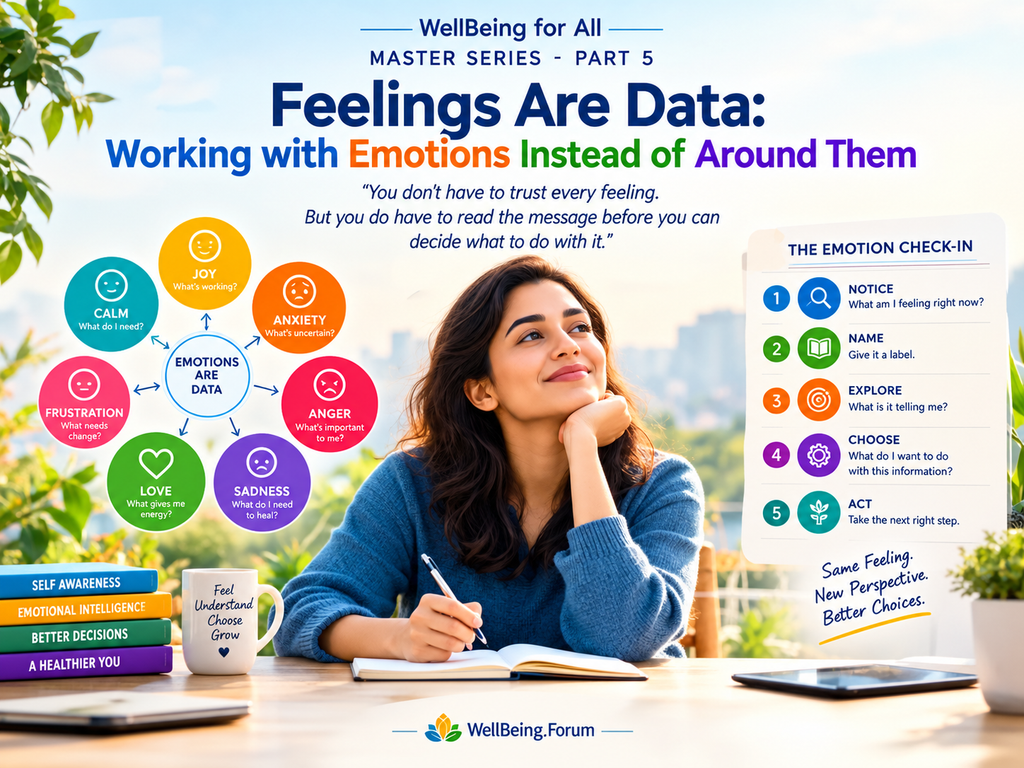
WellBeing for All | Master Series – Part 5
Feelings Are Data: Working with Emotions Instead of Around Them
You don’t have to trust every feeling. But you do have to read the message before you can decide what to do with it.
Kabir, 41, is a finance director in Mumbai. He prides himself on staying composed. When a deal fell through last month, he moved straight to the next task without breaking stride. His team calls him unflappable, and he takes it as a compliment.
His wife noticed something else. He had gone quiet at home, snapping at small things, sleeping badly. When she asked what was wrong, he said, “Nothing. I’m fine.” He believed it.
When Kabir scored his Wellbeing Wheel, Emotions came in at a 4. The prompt asked, Can I name what I’m feeling? He sat with that question longer than any other on the wheel.
Kabir is a composite, but his habit is a common one, especially among people trained to perform calm under pressure. He hadn’t resolved his disappointment. He had filed it somewhere and locked the drawer. This week is about learning to open that drawer safely.
What “Feelings are Data” really means
Many of us learned, early and without anyone quite saying it, that feelings are a problem to manage: something to push down at work, smooth over at home, or fix with a solution as fast as possible. But an emotion is not a malfunction. It’s information, in the same way a dashboard light is information. Anxiety flags a perceived threat. Anger flags a boundary that’s been crossed. Sadness flags a loss. Even less useful-seeming feelings like boredom or irritation are usually pointing at something real.
This week, we treat emotional wellbeing as three abilities:
- Naming what you feel, accurately and without judgement
- Feeling it, meaning letting it move through you instead of pushing it away
- Choosing your response, rather than being run by the feeling in the moment
Consider two ways a river can be treated. Dam it completely and the pressure builds until it bursts somewhere unplanned, at home, in your sleep, in your body. Let it flood with no banks at all and it damages everything nearby. What most of us actually need is a well-built channel: something that lets the water move without either trapping it or letting it run wild. That channel is what this week’s practices try to build.
What the Research says, briefly
- Naming a feeling can lower its intensity. In neuroimaging studies, simply labelling an emotion (“I’m feeling anxious”) has been shown to reduce activity in the amygdala, the brain’s threat-detection centre. Researchers call this “affect labelling,” and the effect shows up even when nothing about the situation has changed. Putting words to a feeling appears to help the brain regulate it.
- Suppression has costs. Studies on expressive suppression, meaning the deliberate effort to hide or push down what you feel, associate it with worse memory for what happened, more strain on relationships, and no actual reduction in the physical stress response. The feeling often continues in the body even when the face and voice give nothing away.
- Reappraisal tends to work better. Reappraisal means viewing a situation differently, for instance seeing a difficult conversation as useful feedback rather than a personal attack, and research generally finds it more effective than suppression for regulating emotion without the same costs.
- Alexithymia, or difficulty identifying and describing feelings, is common and can be built up over time. Some people are raised in environments where emotional expression wasn’t modelled or welcomed, and reduced emotional awareness has also been described after some kinds of chronic stress. Naming feelings is a skill, and like most skills, it responds to practice.
- A wider emotional vocabulary is associated with better regulation. Studies on “emotional granularity” suggest that people who can distinguish between related feelings, such as disappointed, resentful, and hurt, tend to cope somewhat better than people who describe everything as simply “bad” or “stressed.”
- Resilience is built, not fixed. The American Psychological Association describes resilience as a set of learnable behaviours and outlooks, not a fixed trait some people have and others don’t. Social connection, in particular, is one of the most consistent predictors of it.
Three Ways to Begin
⏱ The 5-minute Practice: Name It to Tame It
At any point in your day, especially when something feels “off,” pause and ask three questions:
- What am I feeling right now? Try to go beyond “fine,” “stressed,” or “bad.” Is it disappointment, frustration, worry, embarrassment, envy, relief?
- Where do I feel it in my body? A tight chest, a clenched jaw, a heavy stomach, restless legs.
- What might it be telling me? Not “is this feeling justified,” but “what is it pointing at?”
You don’t need to act on the answer. Just naming it, even silently, can take the edge off. Keep a simple list of feeling words on your phone if “fine” and “stressed” are the only two words that come easily. Building the vocabulary is part of the practice.
⏱ The 30-minute Practice: The Unsent Letter
Choose a situation that’s been sitting heavily with you, a conversation, a setback, a person. Set a timer for thirty minutes and write a letter you will never send.
- Write to the person or situation directly, saying everything you actually feel, without editing for politeness or fairness.
- Don’t worry about being reasonable. This is not a legal document.
- When the timer ends, read it back once if you want to, then close it, delete it, or tear it up. The point was never to send it. The point was to let it out of the locked drawer and onto paper, where you can look at it instead of carrying it.
Many people find that what they actually needed to say, once written honestly, is quite different, and often smaller, than what they’d been rehearsing in their head.
⏱ The this-week Practice: The Feelings Check-in and One Honest Conversation
Twice a day, for one week, pause and name a feeling using the 5-minute practice above. Keep a simple running note: date, one feeling word, one likely trigger. By the end of the week, look for patterns. Does a particular time of day, person, or type of task keep showing up?
Then have one honest conversation. Choose someone you trust, a partner, close friend, sibling, or colleague, and tell them how you actually felt about something this week, instead of the polished version. You might say: “I told you I was fine about the promotion going to someone else, but honestly, I was disappointed, and I think I’m still a bit embarrassed about it.”
This isn’t about venting at length or making someone responsible for fixing your feelings. It’s practice at letting one true sentence out into the open, with someone safe.
If this feels hard for you
- If naming feelings feels foreign or uncomfortable: This is common, especially if you weren’t raised around open emotional expression. Start small, with a single word once a day, and let it build slowly. There’s no deadline on this skill.
- If you were taught that showing emotion is weak or unprofessional: These practices are private. No one needs to see you name a feeling or write an unsent letter. What changes over time is how you carry things, not how visibly you express them.
- If your budget is tight, or your day is packed: All three practices cost nothing but attention. The check-in can happen on a commute, in a queue, or in the two minutes after a hard meeting.
- If you’re in the sandwich generation: Big feelings often get pushed to the back of a long day. Even one line in a phone’s notes app counts as a check-in. Model it gently for children by naming your own feelings aloud sometimes (“I’m feeling a bit frustrated right now, so I’m going to take a breath”).
- If a particular relationship or memory brings up something much bigger than the practice can hold: Stop, and don’t push through it alone. Some feelings, especially ones connected to grief, trauma, or long-standing conflict, are better explored with a trained professional than with a journal and a timer.
- If you lead a team: Composure has its place, but a team that never sees a leader acknowledge difficulty may quietly learn that struggle itself is unacceptable to mention. You don’t need to overshare. A simple “that was a tough call to lose, and I’m disappointed too” can do more for psychological safety than perfect calm.
- If you have limited mobility or a chronic condition: These practices are entirely about internal noticing and writing, so no physical requirement changes anything here.
When to Seek Professional Support
Please speak with a doctor, psychologist or psychiatrist if you feel emotionally numb or disconnected much of the time, if strong feelings arrive and feel impossible to manage or come out in ways that frighten you or hurt people you care about, if low mood or anxiety persists for weeks, or if you find yourself using alcohol, other substances, overworking, or other behaviours to avoid feeling anything at all. If unsent letters, journaling, or naming feelings starts to bring up memories of trauma or abuse that feel too big to hold alone, please stop the exercise and reach out to a trained professional rather than continuing on your own. If you are having thoughts of harming yourself, please reach out immediately. In India, Tele-MANAS (14416) offers free mental health support. If you are in immediate danger, contact emergency services or someone you trust right away.
A Question to carry with you
What is one feeling you’ve told people you don’t have, that you actually do?
Coming Next: Master Series Part 6
Next week we look outward with The Power of Connection: loneliness, friendships, family ties, and how to build genuine belonging into a schedule that rarely has room for it. Keep your Wellbeing Wheel handy, because your Relationships score is the starting point.
WellBeing for All is a 12-part Master Series on Health, Happiness and Harmony in work and life.
If this article made you pause, send it to someone who says “I’m fine” a little too quickly.